
A FOCUSED LOWER-ABDOMINAL SKIN PROCEDURE
Mini tummy tuck surgery for focused lower-abdominal laxity
A mini tummy tuck at BodyLuxe in Chicago removes a limited amount of loose skin from the lower abdomen through a low incision. It is intended for a focused concern below the belly button—not as a smaller version of every full tummy-tuck plan. For the right patient, it can smooth a lower-abdominal fold that liposuction or skin-tightening devices cannot adequately correct.
During consultation, Dr. Farrugia examines where the laxity sits, the abdominal wall, prior scars, your health and future plans, and the change you want. You will leave with a clear recommendation, expected incision, recovery outline, and written quote.

Before-and-after photographs show individual BodyLuxe patients who authorized the use of their images. Each example documents that patient’s outcome at the stated time following the identified procedure or procedures. These examples do not represent or establish the outcome another patient should expect, and no outcome is guaranteed. Results vary based on individual anatomy, health, treatment plan, procedures performed, healing, and adherence to postoperative instructions. All procedures involve risks, benefits, alternatives, and recovery considerations. A qualified licensed clinician must evaluate whether a procedure is appropriate for you and discuss the outcomes and risks reasonably expected in your circumstances.Mini tummy tuck before and after
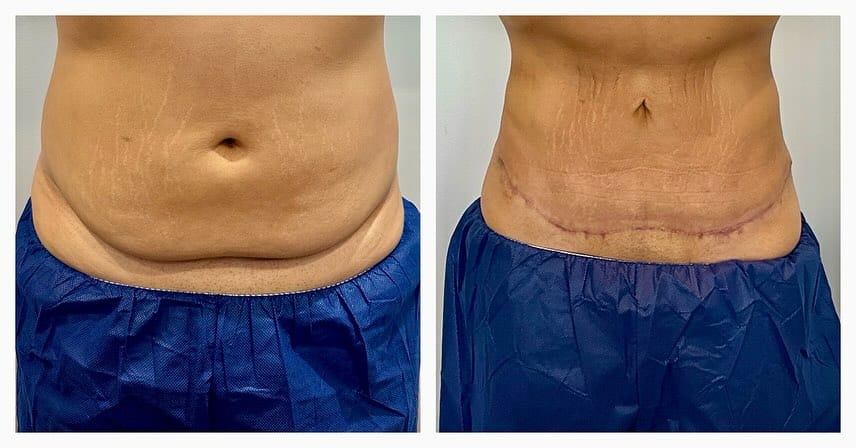 Front
Front
Abdomen, Waist and Flanks
Mini tummy tuck at a glance
Goal
Goal: remove selected loose lower-abdominal skin.
Best fit
Best fit: a limited concern concentrated below the belly button.
Important reality
Reality: this is excisional surgery and leaves a permanent low scar.
What “mini” means in a tummy tuck
“Mini” describes the focused treatment area below the belly button. It can be a meaningful operation for the right anatomy and still requires careful planning, a permanent low scar, and a real recovery.
- We begin by identifying the exact location and amount of loose skin.
- Your abdominal wall, prior operations, weight stability, and future plans help shape the recommendation.
- The incision leaves a permanent scar. Its location and length depend on your surgical plan, anatomy, and healing.
- If skin laxity or abdominal-wall concerns extend above the belly button, a broader operation may address your goals more completely.
How a mini tummy tuck differs from other options
Liposuction removes accessible fat but does not remove a skin fold. Renuvion and Ellacor address selected skin concerns without excising a continuous lower-abdominal segment. A full tummy tuck can treat more extensive skin excess and may involve a different incision and abdominal-wall plan. Your examination determines which category actually matches your anatomy.
Liposuction alone
Liposuction removes localized fat. It may be the better fit when fat is the main concern and the skin can adapt, but it does not remove a lower-abdominal skin fold.
Renuvion
Renuvion may be considered for selected skin-contraction goals, but it does not remove a continuous band of lower-abdominal skin.
Ellacor
Ellacor uses micro-coring for selected skin concerns. It works differently and does not replace surgical removal when a lower-abdominal fold is the main issue.
Full abdominoplasty
A full tummy tuck treats a broader abdominal area and may include a different incision or abdominal-wall plan. It can be more appropriate when laxity extends above the belly button.
Explore Renuvion versus tummy tuck and abdominal liposuction, then use your consultation to compare those options with a mini tummy tuck in one personalized conversation.
Who may be a good candidate for a mini tummy tuck?
A mini tummy tuck may fit when the main concern is a modest fold or laxity below the belly button, weight is reasonably stable, and the upper abdomen does not need the broader correction of a full abdominoplasty. Dr. Farrugia evaluates skin excess, fat, scars, abdominal-wall anatomy, pregnancy or weight-change history, and the position and length of the incision likely to be needed.
- Your main concern is concentrated below the belly button rather than throughout the abdomen.
- Removing loose skin is likely to offer more benefit than treating localized fat alone.
- You are not planning a near-term pregnancy or major weight change that could alter the result.
- You can follow the preparation, aftercare, and activity instructions created for you.
- Your goals match the focused lower-abdominal area the procedure is designed to treat.
When a broader plan may fit better
A full tummy tuck, liposuction, combination plan, or no procedure may be more appropriate when laxity extends above the belly button, abdominal-wall changes are significant, fat is the main concern, or a health factor changes the recommendation.
“Mini” does not automatically define muscle repair or anesthesia. Your written plan explains the exact operation and why it fits your anatomy.
Planning for recovery
Expect soreness, swelling, bruising, tightness, and activity limits during early healing. Your plan may include wound care, compression, positioning, lifting restrictions, and scheduled follow-up. Return to work and exercise depends on the extent of surgery, your work demands, and how you heal.
Your written plan covers wound care, positioning, garments or drains if used, lifting, work, exercise, warning signs, and follow-up. Planning practical help early can make it easier to follow those instructions.
- Arrange practical help during early recovery so you can follow your activity restrictions.
- Use your written plan as your guide rather than comparing your timeline with someone else’s recovery.
- Ask how the proposed incision, aftercare, and activity plan will fit your anatomy and daily responsibilities.
Scars, risks, and limitations
A mini tummy tuck leaves a permanent scar whose length, position, color, and texture can vary. Important risks include bleeding or fluid collection, infection, delayed healing, wound separation, skin or fat necrosis, numbness, asymmetry, contour irregularity, blood clots, anesthesia complications, unsatisfactory scarring, and possible revision. It does not automatically include muscle repair or treat the entire abdomen.
Before you decide, Dr. Farrugia reviews the benefits, risks, alternatives, and scar expected for your plan and explains how to prepare and when to contact the team during recovery.
For additional patient-safety information, review the American Society of Plastic Surgeons tummy tuck safety resource.
What your consultation will clarify
- Whether your main concern comes from loose skin, localized fat, an abdominal-wall change, or a combination.
- Whether the concern is focused enough below the belly button for a mini procedure.
- Where the incision and permanent scar are expected to sit for your anatomy.
- Whether another procedure is being considered and why.
- What preparation, follow-up, recovery support, and activity restrictions you will need.
- Which benefits, risks, limitations, and alternatives matter most for your plan.
- What is included in your individualized written quote.
Mini tummy tuck FAQs
What if my main concern is fat rather than loose skin?
Liposuction removes fat. A mini tummy tuck removes selected loose skin through an incision; the two may sometimes be combined when appropriate.
Will there be a scar?
Yes. Excisional surgery creates a permanent low scar. Its exact length and position depend on the amount and distribution of skin being removed.
What does “mini” mean for anesthesia and recovery?
“Mini” describes the focused treatment area. The anesthesia and recovery plan depend on the exact operation, your health, any combined procedure, and your written instructions.
Does every mini tummy tuck include muscle repair?
Muscle repair is not automatically part of a mini tummy tuck. Your examination and written plan determine whether abdominal-wall treatment is indicated and what operation would be appropriate.
How is pricing determined?
BodyLuxe offers mini tummy tuck for appropriate patients. Pricing depends on your surgical plan, and your consultation includes a written quote explaining what is included. Financing information is available separately.
Find out whether the lower abdomen needs fat removal, skin removal, or both
Dr. Farrugia will examine the amount and location of skin and fat, explain the scar and recovery tradeoffs, and tell you whether a mini tummy tuck is appropriately sized for your concern.