
Alternatives to abdominoplasty: Top 7 Easy Guide
Why Look Beyond a Traditional Tummy Tuck?
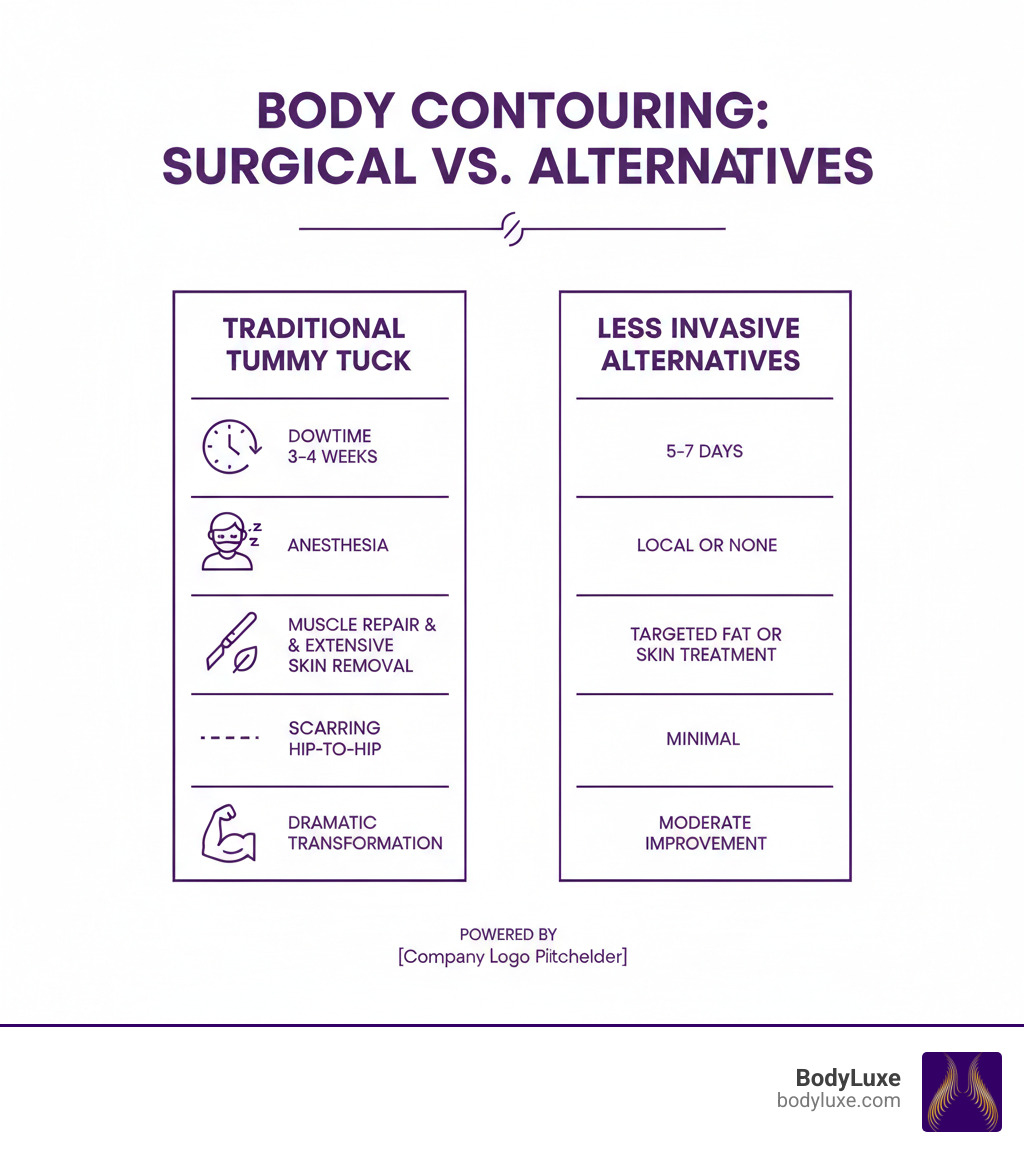
Alternatives to abdominoplasty can improve your abdominal appearance without major surgery. A traditional tummy tuck uses general anesthesia, repairs muscles, removes excess skin, and often requires up to three months of recovery.
Quick Answer: Main Alternatives to Abdominoplasty
Minimally Invasive Surgical Options:
- Mini Tummy Tuck – Smaller incision, targets lower abdomen only, 3-4 week recovery
- Liposuction/Vaser Liposuction – Fat removal only, back to normal in 5-7 days
- AbEX – Combines micro-laser lipo with skin removal, local anesthesia
Non-Surgical Options:
- CoolSculpting (Fat Freezing) – Reduces fat by up to 20% per session
- Radiofrequency/Ultrasound (BodyTite, Renuvion) – Tightens skin 35-60%
- EmSculpt (HIFEM) – Builds muscle through 20,000 contractions per session
- ThermiTight – Heat-based skin tightening for mild laxity
Important Limitation: None of these alternatives can address significant excess skin or repair separated abdominal muscles (diastasis recti) as effectively as a full abdominoplasty.
Many people seek alternatives to avoid the downsides of a full tummy tuck:
- General anesthesia risks: Prefer to avoid 2-5 hours under anesthesia.
- Long recovery: 3-4 weeks before normal activities; ~3 months before exercise.
- Extensive scarring: Hip-to-hip incision leaves a permanent scar.
- High cost: Usually cosmetic and not covered by insurance.
Less invasive options may be enough if your main issues are stubborn fat, mild skin laxity, or limited muscle definition. Some use local anesthesia or none at all, with downtime measured in days.
Not all alternatives suit every concern. Matching the treatment to your anatomy and goals is essential to avoid disappointment.
A Guide to Non-Surgical Alternatives to Abdominoplasty
If the thought of going under the knife makes you nervous, you’re not alone. Non-surgical alternatives to abdominoplasty have become incredibly popular for good reason. They improve your abdominal contour with minimal downtime, often allowing a return to regular activities the same day. With no surgery, you avoid general anesthesia, incisions, and significant scarring. The risk profile is lower than surgical procedures, and results appear gradually for a natural look.
However, it’s crucial to understand their limits. Non-surgical options cannot remove significant excess skin or repair separated abdominal muscles (diastasis recti). Multiple sessions are often needed for full results. These treatments excel at reducing stubborn fat, tightening mild skin laxity, and building muscle—they are for fine-tuning, not dramatic changes.
Fat Reduction Without Surgery: Freezing and Heating
Got stubborn fat that won’t budge no matter how many crunches you do? Non-surgical fat reduction might be your answer.
Cryolipolysis, better known as fat freezing, literally freezes fat cells until they die. The treatment uses controlled cooling to target fat cells while leaving your skin and other tissues unharmed. Over the following weeks, your body naturally processes and eliminates these dead cells through your lymphatic system. You can see up to 20% fat reduction in the treated area after a single session.
Laser lipolysis takes the opposite approach—it melts fat instead of freezing it. This treatment uses controlled laser heat to damage fat cells, which your body then clears away naturally. The heat also stimulates some collagen production, so you might notice a bit of skin tightening as a bonus.
Both methods permanently destroy fat cells in the treated areas. Once those cells are gone, they’re gone for good. However, the remaining fat cells can still expand if you gain weight, so maintaining your results requires a stable weight.
These treatments shine when it comes to targeted fat loss—you can zero in on specific problem areas. They’re completely non-invasive, requiring no incisions or anesthesia, and you can literally have a treatment during your lunch break.
On the flip side, they provide no significant skin tightening effect, so loose skin won’t improve. Results aren’t immediate—you’ll wait weeks or months to see the full effect as your body gradually eliminates the treated fat cells. There’s also a risk of surface irregularities if the treatment isn’t performed correctly, and these procedures are definitely not for overall weight loss.
The ideal candidate has good skin elasticity and small, stubborn fat pockets that resist diet and exercise. If you can pinch an inch or two of fat but your skin snaps back relatively well, you’re probably a great fit.
Skin Tightening with Energy-Based Devices
If your skin has lost some of its youthful firmness but isn’t severely sagging, energy-based devices offer a non-surgical path to tighter, smoother skin.
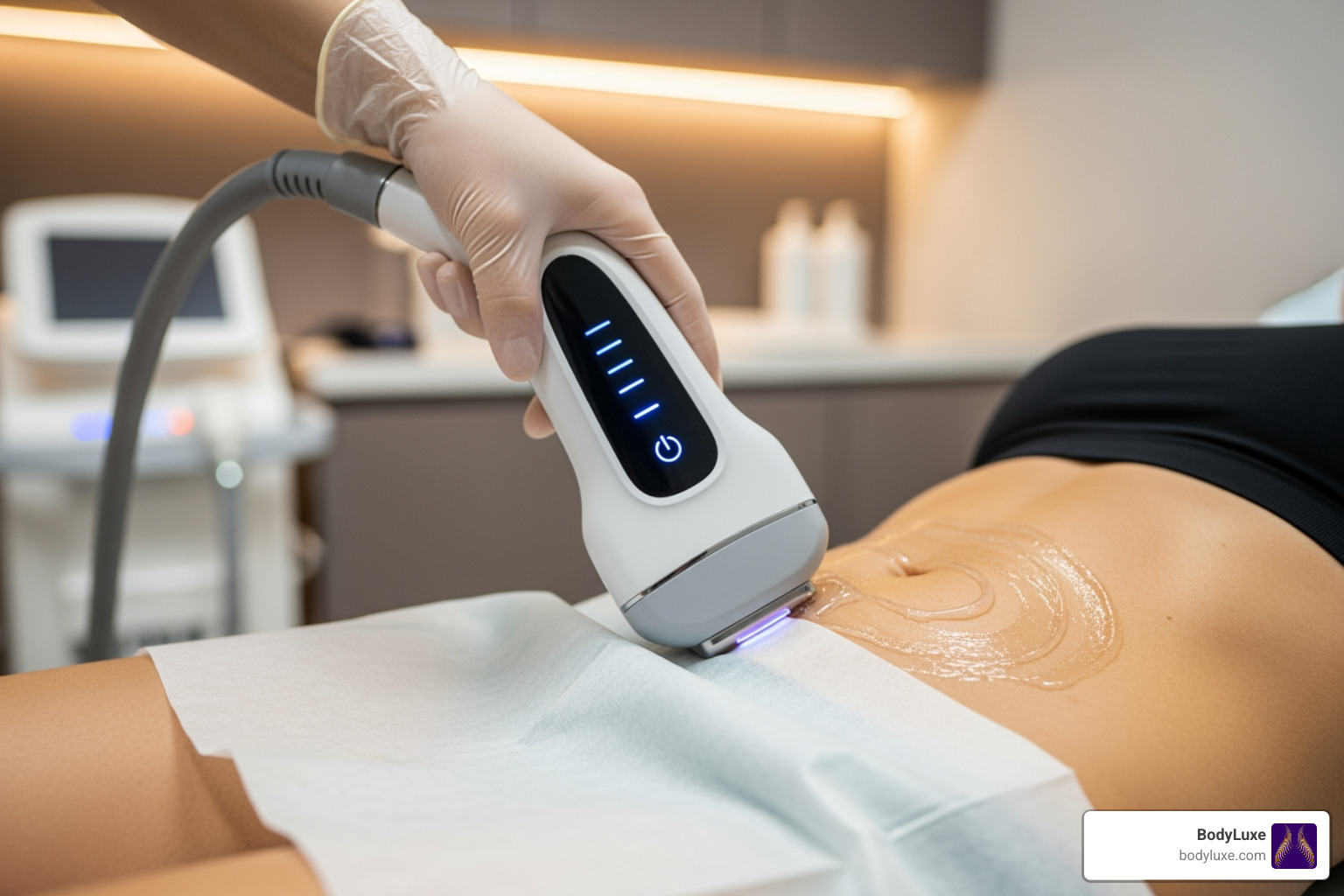
Radiofrequency (RF) energy and ultrasound technology have revolutionized non-surgical skin tightening. These treatments deliver controlled heat energy deep into your skin’s layers, where it works its magic on collagen—the protein that keeps your skin firm and elastic.
The heat does two things simultaneously. First, it causes existing collagen fibers to contract immediately, giving you some instant tightening. Second, it triggers your body’s natural healing response, stimulating the production of fresh, new collagen over the following months. This dual action means your results actually improve over time.
Some RF treatments can contract treated skin by 35% to 45%, while advanced technologies using helium gas and radiofrequency together can achieve up to 60% skin contraction. These are impressive numbers for a non-surgical approach.
These devices improve mild to moderate skin laxity and can even reduce the appearance of cellulite. They work beautifully in combination with other treatments—some patients have them performed alongside liposuction for optimal results. And there’s no surgery and no significant scarring to worry about.
However, the results are often subtle compared to surgical skin removal. If you have severe sagging skin, these treatments won’t deliver the dramatic change you’re hoping for. You’ll typically need multiple treatment sessions, and the results may not be permanent—maintenance treatments help preserve your improvements.
The ideal candidate has some remaining skin elasticity and mild to moderate skin laxity. If your skin has significant excess or hangs loosely, surgical removal remains the only effective solution.
Muscle Toning for a Sculpted Core
Sometimes the issue isn’t fat or loose skin—it’s lack of muscle definition. High-Intensity Focused Electromagnetic (HIFEM) technology offers a unique solution that actually builds muscle without you lifting a finger.
This technology induces powerful muscle contractions that far exceed anything you could achieve through voluntary exercise. We’re talking about 20,000 supramaximal contractions per session—that’s like doing 20,000 crunches in 30 minutes. Your muscles simply can’t contract that or frequently on their own.
The device delivers electromagnetic energy directly to your target muscles, forcing them to contract rapidly and intensely. This extreme workload pushes your muscle tissue beyond its normal limits, triggering a remodeling process. Your muscle fibers adapt by growing stronger and more defined, just like they would from resistance training—but amplified.
This treatment builds genuine muscle mass and improves core strength and definition. It’s non-invasive with zero downtime—you can literally have a session and head straight back to work. Some studies even suggest it may help with mild cases of diastasis recti by strengthening the surrounding muscles, though it cannot surgically repair the separation.
The limitations? It does not directly remove fat or excess skin. While increased muscle mass can improve your overall appearance, it won’t address loose skin or stubborn fat deposits. You’ll need a series of initial sessions and often maintenance treatments to preserve your results. And the results are most visible in individuals who are already relatively lean—if you’re carrying significant excess fat, the muscle definition won’t show through.
The ideal candidate is already close to their goal weight, exercises regularly, and wants to take their abdominal definition to the next level. If you’re lean but struggle to get that sculpted six-pack look, this could be the missing piece of your puzzle.
Minimally Invasive Surgical Options
Sometimes non-surgical treatments just aren’t enough. Maybe you have more skin laxity than energy devices can handle, or fat deposits that need more aggressive removal. But you’re also not ready—or willing—to commit to the full recovery of a traditional tummy tuck. That’s where minimally invasive surgical options shine.
These procedures sit in that sweet spot between non-surgical treatments and major surgery. They’re less invasive than traditional surgery, which means you’re looking at a shorter recovery period—often measured in days or weeks rather than months. Many can be performed with local anesthesia instead of general, significantly reducing anesthesia-related risks. And perhaps most importantly, they create reduced scarring compared to the hip-to-hip incision of a full abdominoplasty.
Think of these as the “just right” option when you need real surgical intervention but want to minimize the impact on your life and body.
The Mini Tummy Tuck: A Targeted Approach
The mini tummy tuck has become one of the most sought-after alternatives to abdominoplasty for good reason. It addresses a very specific problem that many of us face: that stubborn lower belly pooch that won’t budge no matter how many crunches we do.
What it is: A mini tummy tuck involves a smaller incision—typically just a few inches long—placed low on the abdomen where it can be easily hidden by underwear or a bikini bottom. The procedure addresses the lower abdomen only, focusing on the area below your belly button. Through this smaller incision, your surgeon can remove a small amount of skin and fat that’s creating that lower abdominal bulge. There’s also limited muscle tightening possible, usually just in the lower abdominal area, though not all mini tummy tucks include muscle repair.
The beauty of this approach is its precision. If your concerns are concentrated below the navel—maybe from a C-section, weight loss, or just genetics—why undergo a more extensive procedure? The mini tuck targets exactly what needs attention and nothing more.
Recovery is noticeably easier than a full tummy tuck. Most patients are back to light activities within a week or two, and the final results reveal themselves over the following months as swelling subsides. The scar, while permanent, is significantly shorter and positioned where it’s rarely visible.
However, it’s important to understand what a mini tummy tuck can’t do. It won’t address concerns above your belly button, can’t fix significant muscle separation throughout your abdomen, and won’t remove large amounts of excess skin. The results are more subtle than a full tummy tuck—but for the right candidate, that’s exactly what’s needed.
More info about mini tummy tuck services.
Liposuction as one of the alternatives to abdominoplasty
Let’s talk about liposuction—specifically Vaser Liposuction, which represents a significant advancement in fat removal technology and stands as a powerful alternative when fat is your primary concern.
Here’s the fundamental difference between liposuction and a tummy tuck: liposuction removes fat, while a tummy tuck removes skin (and fat). If your skin has good elasticity—meaning it can snap back after being stretched—but you’re carrying stubborn fat deposits that refuse to respond to diet and exercise, liposuction might be your perfect solution.
Vaser Liposuction uses ultrasound-assisted fat removal to achieve remarkably precise results. The process works by liquefying fat before removal. Small probes deliver ultrasound energy beneath your skin, gently breaking apart fat cells and emulsifying them into a liquid form. This liquefied fat is then much easier to remove through thin cannulas, resulting in less trauma to surrounding tissues.
The advantages are compelling. Vaser is effective for fat reduction in targeted areas and can create beautiful definition and contouring—think of those subtle lines that define a toned abdomen. Because the ultrasound technology is gentler than traditional liposuction, patients typically experience less bruising and swelling. The incisions are tiny—just small enough for the cannula to enter—and recovery is impressively quick, with most patients returning to normal activities within 5-7 days.
But here’s the critical limitation we need to discuss honestly: liposuction does not address loose skin or muscle separation. In fact, if you have significant skin laxity, removing the fat that was holding that skin taut can actually make the looseness more noticeable. It’s like deflating a balloon—the balloon itself doesn’t shrink, it just gets wrinkly.
That’s why Vaser Liposuction works best for patients with good skin tone. If you can pinch your abdominal skin and it springs back quickly, your skin elasticity is probably excellent. If it stays wrinkled or takes time to return to position, you might need a procedure that addresses skin as well as fat.
The ideal candidate for liposuction is someone at or near their goal weight with localized fat deposits and firm, elastic skin. It’s not a weight-loss solution—it’s a sculpting tool that refines and defines what’s already there.
Comparing Your Options: Which Procedure Is Right for You?
With so many alternatives to abdominoplasty available, choosing the right path forward can feel overwhelming. The truth is, there’s no single “best” procedure—only the best procedure for you. Your ideal choice depends entirely on what concerns you most, how much improvement you’re hoping for, how much downtime you can handle, and what fits your budget.
Let’s break down the most popular options side by side so you can see how they compare:
| Procedure | Ideal Candidate | Target Issue (Skin/Fat/Muscle) | Downtime (Typical) | Anesthesia (Typical) | Typical Results |
|---|---|---|---|---|---|
| Full Tummy Tuck | Significant loose skin, excess fat, diastasis recti | Skin, Fat, Muscle | 3-4 weeks (normal activities), 3 months (exercise) | General | Dramatic; flat, taut abdomen, muscle repair |
| Mini Tummy Tuck | Mild loose skin (lower abdomen), localized fat | Skin (lower), Fat | 1-2 weeks (normal activities) | Local with sedation, sometimes general | Moderate; flatter lower abdomen, subtle tightening |
| Liposuction (incl. Vaser) | Localized fat deposits, good skin elasticity | Fat | 5-7 days | Local with sedation, sometimes general | Significant fat reduction, improved contour |
| RF Skin Tightening (e.g., BodyTite, Renuvion) | Mild-moderate skin laxity, minimal fat | Skin | Minimal (0-2 days) | Local, topical, or none | Mild-moderate skin tightening, improved texture |
| Fat Freezing (CoolSculpting) | Localized fat pockets, good skin elasticity | Fat | Minimal (0 days) | None | Mild fat reduction (up to 20% per session) |
| HIFEM (EmSculpt) | Lean individuals seeking muscle definition | Muscle | Minimal (0 days) | None | Increased muscle tone and definition, improved strength |
Looking at this comparison, you’ll notice a clear pattern: procedures that deliver more dramatic results typically require more recovery time and more invasive techniques. Meanwhile, non-surgical options offer convenience and minimal downtime, but with more subtle improvements.
The foundation of any successful body contouring journey is a healthy lifestyle. This isn’t just something we say—it’s the absolute truth. No procedure, whether surgical or non-surgical, can replace the benefits of eating well and staying active. If you’re considering any of these alternatives to abdominoplasty, think of them as tools to refine and improve your physique, not as substitutes for taking care of yourself.
Maintaining a stable weight is crucial. Gaining weight after any body contouring procedure can compromise your results. Regular exercise not only helps preserve your outcomes but also improves your overall health and well-being. A balanced diet supports your body’s healing process and helps you maintain the contours you’ve worked to achieve.
Be cautious of treatments that sound too good to be true—because they usually are. The wellness industry is full of products and services that promise dramatic results without effort or scientific backing. Here’s what to watch out for:
“Miracle” creams might improve your skin’s texture or hydration, but they cannot melt fat or significantly tighten loose skin. If a cream could do that, plastic surgeons would be out of business.
Body wraps may make you lose a few pounds temporarily through water loss, but this effect disappears as soon as you rehydrate. They don’t reduce fat or permanently tighten skin.
At-home devices marketed for body contouring typically lack the power and precision of professional-grade equipment. While some may provide very mild benefits, most offer negligible or inconsistent results that won’t justify the investment.
At BodyLuxe, Dr. Farrugia takes the time to evaluate your unique anatomy and goals during a personalized consultation. This conversation is where we determine which option—or combination of options—will give you the results you’re hoping for. Because at the end of the day, the right procedure is the one that addresses your specific concerns and fits into your life.
Frequently Asked Questions about Tummy Tuck Alternatives
Can non-surgical alternatives fix diastasis recti (muscle separation)?
This is one of the most important questions we hear, and we want to be completely honest with you: no, non-surgical methods cannot fix diastasis recti.
Diastasis recti—the separation of your rectus abdominis muscles that often happens during pregnancy or after significant weight changes—requires actual surgical repair. Think of it like this: those muscles need to be physically sutured back together, and there’s simply no way around that with non-surgical treatments.
Now, treatments like EmSculpt can absolutely strengthen your abdominal muscles and improve your core strength. You might even notice the area feels firmer and more toned. But here’s the critical distinction: while these devices build muscle tissue, they cannot bring separated muscles back together or close the gap that defines diastasis recti.
If you have true muscle separation that bothers you, a full abdominoplasty is typically the only way to address it properly. During a consultation, Dr. Farrugia can assess the extent of your muscle separation and help you understand which approach will actually solve your specific concern.
How much do alternatives to abdominoplasty cost?
The honest answer? It varies quite a bit, and that’s actually good news because it means there are options for different budgets.
Non-surgical treatments typically cost less per session. For example, fat freezing sessions might run anywhere from $500 to $1,500 each, radiofrequency treatments from $200 to $500 per session, and HIFEM therapy like EmSculpt around $2,000 to $4,000 for a complete series. The catch is that you usually need multiple sessions to see the results you want, so those costs can add up over time.
Minimally invasive surgical procedures like a mini tummy tuck or liposuction fall somewhere in the middle. They’re more of an investment than non-surgical options but less than a full tummy tuck.
Here’s what we always tell patients: the “best value” isn’t necessarily the lowest price tag. It’s the treatment that actually addresses your concern and gives you lasting results. Spending less on something that doesn’t work for your body isn’t a bargain at all.
The best way to understand what you’ll actually need to invest is to come in for a consultation. We can look at your specific situation, discuss your goals, and give you accurate pricing based on what will actually work for you—not a one-size-fits-all quote.
How long do the results last and what maintenance is required?
This is where understanding what each treatment actually does becomes really important. Different alternatives to abdominoplasty have different lifespans, and knowing this upfront helps set realistic expectations.
When it comes to fat removal—whether through CoolSculpting or liposuction—the fat cells that are destroyed are gone for good. They don’t come back. But (and this is a big but) the remaining fat cells can still expand if you gain weight. Your body can also create new fat deposits in other areas. So while the specific fat pockets you treated are permanently reduced, maintaining your results absolutely depends on keeping your weight stable.
For skin tightening treatments using radiofrequency or ultrasound, you can typically enjoy results for several months to a few years. However, your skin continues to age, sun exposure keeps affecting it, and weight changes will impact elasticity. Many of our patients choose to come in for maintenance sessions every 6-12 months to keep their skin looking its best. Think of it like regular facials for your body.
Muscle toning results from treatments like EmSculpt can be impressively long-lasting, but muscles are living tissue that need continued stimulation. If you stop working out entirely, those muscles will eventually decrease in size and tone—just like they would if you stopped going to the gym. Regular exercise is essential, and some patients add periodic EmSculpt sessions to maintain peak definition.
Here’s the bottom line we share with every patient: these treatments work beautifully, but they’re not magic. They work best when you’re already committed to taking care of yourself. A healthy diet, regular exercise, and a stable weight are what make any body contouring results last. We like to think of these procedures as giving you an amazing head start—but the maintenance is a partnership between the treatment and your lifestyle choices.
Your Personalized Path to a Toned Abdomen
We’ve covered a lot of ground together, exploring everything from non-surgical fat freezing to minimally invasive procedures. The truth is, there’s no one-size-fits-all answer when it comes to alternatives to abdominoplasty. What works beautifully for your friend might not be the right choice for you—and that’s exactly why a personalized approach matters so much.
Before you take the next step, spend a moment thinking about what bothers you most when you look in the mirror. Is it the loose skin that no amount of exercise seems to fix? If you’re dealing with significant excess skin, particularly after pregnancy or major weight loss, a mini tummy tuck might be your best bet. But if your skin laxity is mild to moderate, energy-based skin tightening could give you the improvement you’re looking for without surgery.
Maybe stubborn fat pockets are your main concern—those frustrating areas that stick around despite your best efforts at the gym. Liposuction can sculpt away those deposits, while non-surgical options like fat freezing or laser lipolysis offer a gentler approach with zero downtime.
Or perhaps you’re actually pretty happy with your weight and skin, but you’re after better muscle definition. If that’s the case, HIFEM technology might be the missing piece in your fitness puzzle, helping you build that sculpted core you’ve been working toward.
Here’s what we know after years of helping people achieve their body goals: the most important step you can take is scheduling a professional consultation. We can give you all the information in the world through articles like this one, but nothing replaces an in-person evaluation where we can assess your individual anatomy and really understand what you’re hoping to achieve.
At BodyLuxe, Dr. Farrugia and our team take exceptional patient care seriously. That means we don’t rush through consultations or push you toward the most expensive option. Instead, we take the time to carefully evaluate your skin quality, examine your fat distribution, check your muscle tone, and listen to your goals. We’ll talk honestly about what’s realistic, which procedures will work best for your specific situation, and what kind of results you can expect.
Creating a personalized treatment plan for your unique needs isn’t just our job—it’s what we love doing. We want you to walk away from your consultation feeling informed, confident, and excited about the path ahead. Whether that’s a mini tummy tuck, a combination of treatments, or even a recommendation to wait until you’ve reached a more stable weight, we’ll give you our honest professional opinion.
The journey to a more confident you starts with a conversation. Let us help you figure out which of these alternatives to abdominoplasty makes the most sense for your body, your lifestyle, and your goals.