
Tretinoin Before and After: Unveil 1st Magic
Why Tretinoin Before and After Results Matter
Tretinoin before and after results showcase some of the most dramatic changes available in skincare. If you’re wondering what it can do for your skin, here’s what research shows:
Quick Answer: What to Expect from Tretinoin
| Skin Concern | Expected Timeline | Key Improvements |
|---|---|---|
| Acne & Breakouts | 8-12 weeks | Fewer pimples, unclogged pores, reduced inflammation |
| Fine Lines & Wrinkles | 3-6 months | Smoother texture, increased firmness, up to 80% more collagen |
| Dark Spots & Hyperpigmentation | 12+ weeks | More even tone, faded sun damage, reduced melasma |
| Overall Skin Texture | 4-8 weeks | Healthier glow, refined pores, smoother surface |
Tretinoin isn’t a trend; it’s a prescription-strength retinoid backed by over 50 years of research and considered the gold standard for anti-aging and acne treatment.
However, tretinoin is powerful. Your skin needs time to adjust, and the first few weeks can be rough, involving dryness, peeling, and even a temporary increase in breakouts. This is a normal and expected part of the process.
The key to success is patience and consistency. You won’t see perfect skin overnight, but if you stick with it, the change can be remarkable.
This guide will walk you through what tretinoin does, what your journey might look like, and how to use it safely to get the results you want.
What is Tretinoin and How Does It Work?
If you’re researching effective skincare, you’ve likely heard of tretinoin. But what is it, and why do tretinoin before and after photos show such dramatic changes?
Tretinoin is a vitamin A derivative, specifically pure retinoic acid. Unlike over-the-counter products like retinol, it’s the most active form your skin can use and requires no conversion to start working. Your skin cells recognize and respond to it immediately.
This potency makes tretinoin prescription-strength. It’s a medication studied for over 50 years, and as board-certified dermatologist Azadeh Shirazi, MD, calls it, “the gold standard for improving skin texture and fine lines.”
How Tretinoin Actually Works
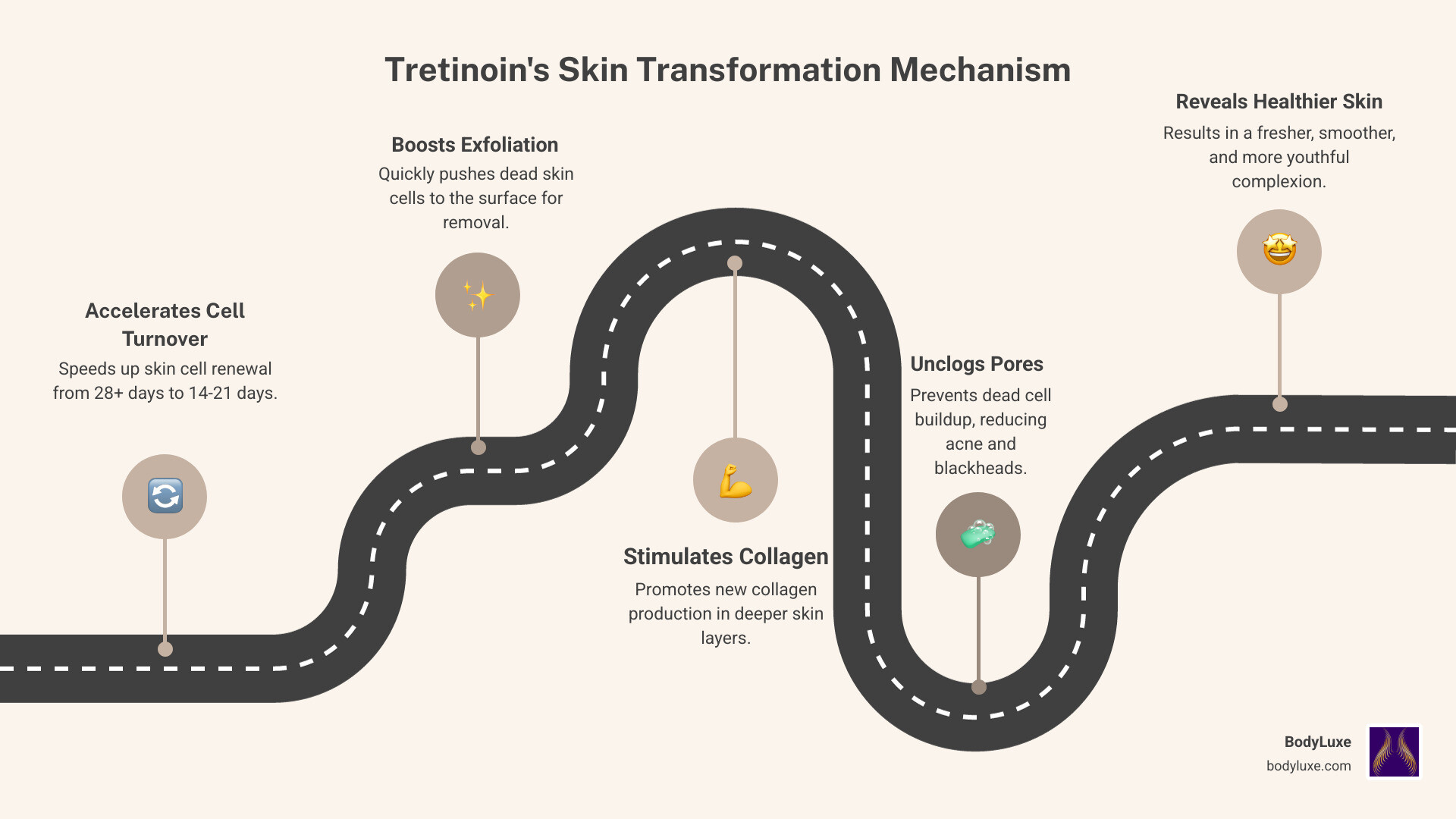
Tretinoin transforms skin on a cellular level in three key ways:
- It speeds up cell turnover. As we age, our skin’s renewal process slows. Tretinoin accelerates this, pushing out old cells and bringing fresh ones to the surface for a smoother, more radiant complexion.
- It boosts collagen production. We lose about 1% of collagen annually after age 20, leading to wrinkles. Tretinoin stimulates new collagen synthesis, with studies showing up to an 80% increase over 10-12 months of nightly use. This rebuilds the skin’s foundation from within. You can read more about the scientific overview of retinoids in skin aging.
- It unclogs pores. By preventing dead skin and oil buildup, it treats existing acne, prevents new breakouts, and helps minimize the appearance of enlarged pores.
Essentially, tretinoin teaches your skin to behave like younger, healthier skin, which is why dermatologists have trusted it for decades.
Tretinoin vs. Retinol: What’s the Difference?
Many people confuse tretinoin and retinol. While both are vitamin A derivatives (retinoids), they are quite different. Tretinoin is pure retinoic acid, the active form your skin uses directly. Retinol is gentler and must be converted into retinoic acid by the skin, losing potency in the process.
The key difference is potency: Tretinoin is about 20 times more potent than retinol.
| Key Aspect | Tretinoin | Retinol |
|---|---|---|
| Potency | Pure retinoic acid; highly potent | Requires conversion to retinoic acid; less potent |
| Strength | Up to 20 times more potent than retinol | Milder, typically 0.1% to 1% in OTC products |
| Conversion | None needed; immediately active | Requires two conversion steps in the skin |
| Speed of Results | Faster, more dramatic results | Slower, more gradual results |
| Irritation Potential | Higher, more noticeable side effects initially | Lower, generally gentler with fewer side effects |
| Availability | Prescription-only in the U.S. | Over-the-counter (OTC) in various formulations |
| Primary Use | Acne, anti-aging, hyperpigmentation | Anti-aging, mild acne, texture improvement |
Tretinoin’s strength delivers faster, more dramatic results but also carries a higher risk of initial irritation like dryness and peeling. Retinol is gentler, making it a good starting point for beginners or those with sensitive skin.
For significant acne, advanced aging, or stubborn dark spots, dermatologists often recommend prescription-strength tretinoin. It’s a heavy hitter that delivers real results when used correctly.
The Tretinoin Change: A Visual Before and After Journey
Tretinoin works beautifully, but not overnight. It’s crucial to set realistic expectations and commit to the long game.
Documenting your progress with photos is a must. Daily mirror checks make gradual changes hard to spot, but comparing photos over several weeks reveals the real progress—the smoothness, clarity, and glow—which is incredibly motivating.
Consistency is everything. Stick with your routine even through dryness or irritation. Skipping applications or stopping will only delay results and reset your skin’s adjustment process. Trust the process and give your skin the chance to transform.
Most people see initial improvements around six weeks of nightly use. If you use it less frequently, expect results to take longer. For the full spectrum of benefits, like significant collagen rebuilding, you might need several months to a full year of consistent use. Patience and consistency are your best friends on this journey.
Let’s look at what you can expect for specific skin concerns.
Acne and Clogged Pores: A Tretinoin Before and After Story
Tretinoin is a highly effective treatment for all types of acne, from blackheads and whiteheads (comedonal acne) to red, swollen pimples (inflammatory acne).
It works by speeding up cell turnover to prevent clogged pores and has anti-inflammatory properties to calm existing breakouts. However, before your skin improves, it might get worse. This is the normal “tretinoin purge.” As tretinoin accelerates cell turnover, it pushes underlying clogs to the surface, causing a temporary increase in breakouts. This frustrating phase typically lasts a few weeks and is a sign the medication is working.
Expected timeline for acne: You’ll likely see fewer new breakouts within 8 to 10 weeks. For a significant reduction in all forms of acne, plan on 12 weeks or more of consistent use.
Anti-Aging: A Tretinoin Before and After Timeline for Wrinkles
For anti-aging, tretinoin is an excellent choice because it rebuilds skin from the inside out.The magic is collagen stimulation. Tretinoin reverses age-related collagen loss by ramping up its production. A landmark study confirmed its ability to restore collagen, with research showing up to an 80% increase over 10-12 months of nightly use. This provides structural change, not just a surface fix.
Expected timeline for anti-aging:
- 4 to 8 weeks: A healthy glow and smoother texture appear.
- 8 weeks to 3 months: Visible improvements in fine lines and skin firmness.
- 3 to 6 months: Deeper wrinkles begin to soften.
- 10 to 12 months: Maximum collagen remodeling and dramatic anti-aging results.
Hyperpigmentation and Uneven Tone
Tretinoin effectively fades dark spots and uneven tone, revealing a brighter, more uniform complexion.Hyperpigmentation is an overproduction of melanin, causing discoloration from sun damage, post-inflammatory hyperpigmentation (PIH) from acne, or melasma from hormonal changes. Tretinoin tackles this by dispersing melanin clusters and accelerating the shedding of pigmented surface cells.
Expected timeline for hyperpigmentation: For concerns like PIH, melasma, and sun damage, you can expect visible fading within 12 weeks of consistent use. Achieving a truly even skin tone takes patience, but the gradual brightening is worth it.
Your Tretinoin Roadmap: Application and Side Effect Management
Using tretinoin correctly from the start is key to achieving great results while minimizing frustration. The most important principle is to start slow and low. Begin with a low concentration (e.g., 0.025%) just once or twice a week to allow your skin to build tolerance.
As your skin acclimates, you can gradually increase the frequency to every other night, or even nightly for maximum tretinoin before and after results. However, consistency is more important than frequency; find what your skin can comfortably tolerate.
Always apply tretinoin at night, as sunlight makes it less effective and increases your skin’s sun sensitivity. Remember the pea-sized amount rule: a small dollop is enough for your entire face. More is not better and will only cause irritation. Apply a thin layer to clean, completely dry skin (wait 20-30 minutes after washing).
Navigating the “Retinoid Uglies”: Common Side Effects
The first few weeks with tretinoin can be challenging. This adjustment phase, known as the retinization period or “retinoid uglies,” is a normal part of the process. For the first 4-8 weeks, you may experience dryness, peeling, redness, and mild stinging. For acne users, this is also when the “purge” can occur.
Board-certified dermatologist Marisa Garshick, MD, confirms this, noting that “Tretinoin may cause skin irritation, including redness, dryness, and skin sensitivity.” For expert advice on managing irritation, consulting a dermatologist is recommended. These side effects are temporary and fade as your skin adapts.
How to Build a Tretinoin-Friendly Skincare Routine
A supportive skincare routine helps you get better results by keeping your skin healthy and protected. Here’s what you need:
- Gentle, hydrating cleansers: Use a mild, non-foaming cleanser that won’t strip your skin’s protective barrier.
- The moisturizer sandwich technique: To reduce irritation, apply a layer of moisturizer, then your tretinoin, and finish with another layer of moisturizer. This buffers the intensity without compromising effectiveness.
- Hyaluronic acid serums: Apply to damp skin before your moisturizer to boost hydration.
- Broad-spectrum SPF 30 or higher: This is non-negotiable. Tretinoin makes skin highly sun-sensitive. As Dr. Lana Kashlan advises, “The most important thing with tretinoin use is to make sure that you’re using lots of moisturizer and lots of sun protection during the daytime.” Wear it daily, rain or shine.
- Ingredients to use with caution: Avoid using AHAs, BHAs, and Benzoyl Peroxide at the same time as tretinoin to prevent over-irritation. Use Vitamin C in the morning and tretinoin at night to get the benefits of both without conflict.
Listen to your skin. If irritation becomes overwhelming, take a night or two off. Slowing down is better than stopping altogether.
Frequently Asked Questions about Tretinoin
Here are straightforward answers to the most common questions people have when starting their tretinoin before and after journey.
Is Tretinoin Gel or Cream Better?
Both gel and cream formulations are equally effective; the difference is the base, which suits different skin types.
- Tretinoin gel has a lightweight, alcohol-based formula ideal for oily or acne-prone skin. It absorbs quickly and helps control excess oil.
- Tretinoin cream has a richer, hydrating base, making it the go-to for dry, sensitive, or mature skin. Its emollient properties help counteract tretinoin-induced dryness.
Your dermatologist will help you choose the right formulation for your skin type and goals.
Can You Use Tretinoin Under Your Eyes?
Yes, but with extreme caution, as the skin here is very thin. Applying it too close to the lash line can cause intense irritation. As guided by board-certified dermatologist Rishi Chopra, MD, “Begin with a low concentration and only lightly sweep the product toward the bony part around the eye, never directly on the lash line.”
The best approach is to apply a tiny amount to the orbital bone (the bony ridge around your eye socket). The product will migrate slightly inward. Consider buffering with an eye cream using the sandwich technique: eye cream, a dot of tretinoin, then more eye cream. Start with a low concentration and low frequency, and consult your dermatologist if irritation occurs.
How Do You Get a Tretinoin Prescription?
In the U.S., tretinoin is a prescription-only medication. This ensures you receive professional guidance on the correct strength and usage for your skin.
You can get a prescription through an in-person consultation with a licensed provider like a dermatologist or via a telehealth platform that connects you with a provider virtually. This is a convenient option whether you’re in Chicago or elsewhere.
The importance of professional guidance is paramount. A provider will help you manage side effects, adjust concentrations, and integrate tretinoin safely into your routine for the best tretinoin before and after results.
At BodyLuxe, Dr. Farrugia champions this philosophy of personalized, expert guidance. Just as tretinoin requires professional oversight, all cosmetic treatments benefit from the expertise of a skilled provider who understands your unique goals.
Conclusion: Your Path to Transformed Skin
Tretinoin is not a fleeting trend; it’s a prescription-strength powerhouse backed by decades of research, capable of changing your skin from the inside out. The tretinoin before and after results are clear: smoother skin, fewer breakouts, reduced wrinkles, and faded dark spots. It’s a proven solution for acne, aging, and hyperpigmentation.
However, tretinoin requires commitment. It demands patience through the initial adjustment period, consistency in application, a supportive routine (gentle cleanser, moisturizer, SPF), and trust in the process, as the best results take months to appear.
You don’t have to figure this out alone. Expert guidance is crucial in any cosmetic journey. At BodyLuxe, Dr. Farrugia emphasizes personalized care for optimal results, because every person’s skin is unique. Having a knowledgeable provider makes all the difference between frustration and success.
If you’re considering tretinoin, consult with a licensed provider who can assess your skin and guide you through the process. With professional support and consistency, you can open up tretinoin’s full potential and achieve the kind of change that makes you feel confident in your own skin. Your journey to healthier, more radiant skin is worth the wait.